| Lesson 2 | Scope resolution operator |
| Objective | This page describes the unary and binary forms of the scope resolution operator in C++ |
C++ Scope Resolution Operator: Unary and Binary Forms
Introduction to Scope Resolution in C++
The
The scope resolution operator is the highest precedence operator in the C++ language, operating at compile-time to resolve identifier ambiguity. It comes in two fundamental forms: unary and binary. The unary form accesses global scope, while the binary form qualifies identifiers with their enclosing scope (class, namespace, or enumeration). Understanding both forms is essential for writing clear, maintainable C++ code, especially as projects grow in complexity and incorporate modern C++ features like namespaces, templates, and inline variables introduced in C++17.
class construct adds a new set of scope rules to those you are already familiar with in C++. One of the fundamental purposes of classes is to provide an encapsulation technique that isolates implementation details from the external interface. Conceptually, it makes sense that all names declared within a class be treated as if they were in their own namespace, distinct from external names, function names, and other class names. This separation creates a need for the scope resolution operator (::), which serves as the bridge between different naming contexts.
The scope resolution operator is the highest precedence operator in the C++ language, operating at compile-time to resolve identifier ambiguity. It comes in two fundamental forms: unary and binary. The unary form accesses global scope, while the binary form qualifies identifiers with their enclosing scope (class, namespace, or enumeration). Understanding both forms is essential for writing clear, maintainable C++ code, especially as projects grow in complexity and incorporate modern C++ features like namespaces, templates, and inline variables introduced in C++17.
The Scope Resolution Operator: Purpose and Context
The scope resolution operator helps to identify and specify the context to which an identifier refers. In C++, names can exist in multiple scopes simultaneously—global scope, namespace scope, class scope, local scope, and even nested class scope. When the same identifier appears in multiple contexts, the scope resolution operator provides unambiguous access to the intended entity.
The operator consists of two consecutive colons (::) and serves several critical functions:
In modern C++ development, the scope resolution operator has become even more important with the widespread adoption of namespaces to prevent name collisions in large codebases. Libraries like the Standard Template Library (STL) rely heavily on the
The operator consists of two consecutive colons (::) and serves several critical functions:
- Defining member functions outside their class declarations
- Accessing global variables when local variables have the same name
- Qualifying names within namespaces
- Accessing static class members without an object instance
- Defining specialized templates and nested class members
- Accessing enumeration constants in scoped enumerations (C++11)
In modern C++ development, the scope resolution operator has become even more important with the widespread adoption of namespaces to prevent name collisions in large codebases. Libraries like the Standard Template Library (STL) rely heavily on the
std:: namespace prefix, making the scope resolution operator one of the most frequently used operators in contemporary C++ code.
Unary Form: Accessing Global Scope
The unary form of the scope resolution operator consists of the :: symbol placed directly before an identifier, with no qualifying scope name to its left. This form explicitly accesses the global scope, allowing you to reference global variables or functions even when local identifiers have the same name.
Consider this fundamental example demonstrating the unary form:
Consider this fundamental example demonstrating the unary form:
#include <iostream>
using namespace std;

int n = 12;   // A global variable

int main() {
   int n = 13;   // A local variable with the same name
   cout << ::n << endl;  // Print the global variable: 12
   cout << n   << endl;  // Print the local variable: 13
}
C++ Classes
In this example,
The unary form becomes particularly valuable in several scenarios:
Accessing Global Functions: When a class member function has the same name as a global function, you can call the global version using the unary operator:
::n explicitly refers to the global variable, while n alone refers to the local variable in the closest enclosing scope. Without the unary scope resolution operator, there would be no way to access the global n from within main() once the local n is declared, as the local declaration hides the global one.
The unary form becomes particularly valuable in several scenarios:
Accessing Global Functions: When a class member function has the same name as a global function, you can call the global version using the unary operator:
void print() {
    std::cout << "Global print function\n";
}

class MyClass {
public:
    void print() {
        std::cout << "Member print function\n";
    }

    void test() {
        print();     // Calls member function
        ::print();   // Calls global function
    }
};
Working with Namespaces: The unary form also applies when working with nested namespaces. While you might typically use a qualified name like
std::cout, the unary operator can access the truly global scope, bypassing all namespace contexts:
int value = 100;  // Global scope

namespace outer {
    int value = 200;

    namespace inner {
        int value = 300;

        void display() {
            std::cout << ::value << '\n';        // Prints 100 (global)
            std::cout << outer::value << '\n';   // Prints 200
            std::cout << value << '\n';          // Prints 300 (local)
        }
    }
}
Binary Form: Qualifying Class and Namespace Members
The binary form of the scope resolution operator is more commonly encountered in C++ programming. It takes the form
Defining Member Functions Outside the Class: The most fundamental use of the binary form is defining member functions outside their class declaration. The scope resolution operator in this context tells the compiler that the function definition belongs to a specific class:
scope_name::identifier, where scope_name can be a class name, namespace name, or enumeration name. This form qualifies the identifier on the right with the scope on the left, providing precise control over name resolution.
Defining Member Functions Outside the Class: The most fundamental use of the binary form is defining member functions outside their class declaration. The scope resolution operator in this context tells the compiler that the function definition belongs to a specific class:
class Account {
private:
    double balance;
public:
    Account(double initial);
    double getBalance();      // Declaration only
    void deposit(double amount);
};

// Definition outside the class using binary form
double Account::getBalance() {
    return balance;
}

void Account::deposit(double amount) {
    balance += amount;
}

// Constructor definition
Account::Account(double initial) : balance(initial) {
}
The declarator
Accessing Static Members: Static class members can be accessed using the binary form without requiring an object instance. This is a common pattern in C++ for class-level data and utility functions:
Account::getBalance() means "the getBalance() member function of the Account class." This syntax is essential because once outside the class body, the function name alone would be ambiguous—the compiler needs to know which class the function belongs to.
Accessing Static Members: Static class members can be accessed using the binary form without requiring an object instance. This is a common pattern in C++ for class-level data and utility functions:
class MathUtils {
public:
    static constexpr double PI = 3.14159265359;
    static int add(int a, int b) { return a + b; }
};

int main() {
    double circumference = 2 * MathUtils::PI * radius;
    int sum = MathUtils::add(5, 7);  // No object needed
}
Nested Classes and Scope Resolution: When working with nested classes, the scope resolution operator can be chained to access deeply nested types or members:
class Outer {
public:
    class Inner {
    public:
        class DeepNest {
        public:
            static void display() {
                std::cout << "Deeply nested class\n";
            }
        };
    };
};

int main() {
    // Accessing a static member of a doubly-nested class
    Outer::Inner::DeepNest::display();

    // Creating an instance of a nested class
    Outer::Inner::DeepNest obj;
}
Member Functions Defined Outside the Class
So far we have seen member functions that were defined inside the class definition. This need not always be the case. Separating the declaration from the definition is a common practice in C++, particularly for larger classes where keeping all implementations inline would make the class declaration difficult to read. The following example shows a member function,
Inside the class, only the declaration appears:
add_dist(), that is declared within the Distance class definition but defined outside of it.
Inside the class, only the declaration appears:
class Distance {
private:
    int feet;
    double inches;
public:
    Distance() : feet(0), inches(0.0) { }
    Distance(int ft, double in) : feet(ft), inches(in) { }
    void add_dist(Distance, Distance);  // Declaration only
    void display() const;
};
This tells the compiler that
add_dist() is a member function of the class but that it will be defined elsewhere in the source file. The actual definition follows the class declaration and uses the scope resolution operator to associate the function with its class:
// Add lengths d2 and d3, store result in calling object
void Distance::add_dist(Distance d2, Distance d3) {
    inches = d2.inches + d3.inches;  // Add the inches
    feet = 0;                        // Initialize feet (for carry)

    if (inches >= 12.0) {            // If total exceeds 12.0,
        inches -= 12.0;              // decrease inches by 12.0
        feet++;                      // and increase feet by 1
    }

    feet += d2.feet + d3.feet;       // Add the feet
}

void Distance::display() const {
    std::cout << feet << "' " << inches << "\"";
}
The declarator in this definition contains the scope resolution syntax. The function name,
add_dist(), is preceded by the class name, Distance, and the scope resolution operator (::). This combination Distance::add_dist() means the add_dist() member function of the Distance class. Figure 3.2 illustrates the components of this syntax.
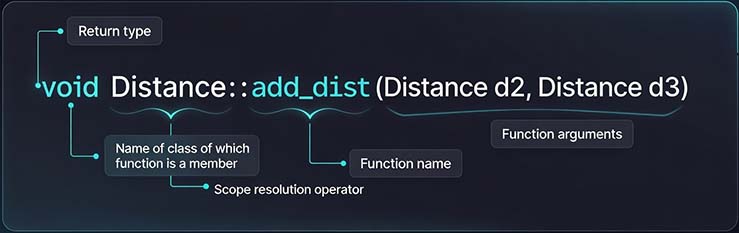
void Distance::add_dist(Distance d2, Distance d3)
- Return type
void - Name of class of which function is a member
Distance - Scope resolution operator
:: - Function name
add_dist - Function arguments
Distance d2, Distance d3
This diagram is illustrating how a member function is defined outside the class definition using the scope resolution operator
::.
Figure 3.2 The scope resolution operator.
Modern C++ Features and Scope Resolution
Since C++11, several language enhancements have expanded the contexts in which the scope resolution operator appears. Understanding these modern uses is essential for working with contemporary C++ codebases.
Scoped Enumerations (C++11): Unlike traditional enums, scoped enumerations require the scope resolution operator to access their enumerators:
Scoped Enumerations (C++11): Unlike traditional enums, scoped enumerations require the scope resolution operator to access their enumerators:
// Traditional enum (unscoped)
enum Color { RED, GREEN, BLUE };
Color c1 = RED;  // Direct access

// Scoped enum (C++11)
enum class Status { SUCCESS, FAILURE, PENDING };
Status s1 = Status::SUCCESS;  // Must use scope resolution
Inline Variables (C++17): C++17 introduced inline variables, allowing static member variables to be initialized directly in the class declaration. The scope resolution operator is still used when accessing these members:
class Configuration {
public:
    inline static const std::string APP_NAME = "MyApp";
    inline static const int MAX_CONNECTIONS = 100;
};

// Access without creating an instance
std::string name = Configuration::APP_NAME;
Nested Namespace Definitions (C++17): C++17 simplified nested namespace declarations, but accessing nested namespace members still requires the scope resolution operator:
// C++17 nested namespace syntax
namespace company::project::utils {
    void helper() { }
}

// Accessing the function
company::project::utils::helper();
Concepts (C++20): Template constraints introduced in C++20 sometimes require scope resolution when using named concepts:
template<typename T>
concept Numeric = std::is_arithmetic_v<T>;

template<Numeric T>
T multiply(T a, T b) {
    return a * b;
}
Explicit Object Parameters (C++23): C++23's deducing
this feature still uses scope resolution for static member access, but provides a cleaner syntax for member function chaining:
struct Builder {
    int value = 0;

    // C++23: explicit object parameter
    auto&& setValue(this auto&& self, int v) {
        self.value = v;
        return std::forward<decltype(self)>(self);
    }
};
Template Specialization and Scope Resolution
Template specializations frequently require the scope resolution operator when defining specialized versions of member functions:
template<typename T>
class Container {
public:
    void process();
};

// Generic implementation
template<typename T>
void Container<T>::process() {
    std::cout << "Generic processing\n";
}

// Specialization for int
template<>
void Container<int>::process() {
    std::cout << "Specialized processing for int\n";
}
Common Pitfalls and Best Practices
Avoiding Ambiguity: One common mistake is assuming that the scope resolution operator is always required. Within a member function, you can access other members directly without qualification:
class MyClass {
private:
    int value;
public:
    void setValue(int v) {
        value = v;        // Correct: direct access
        // this->value = v;  // Also correct but verbose
        // MyClass::value = v;  // Unnecessary and potentially confusing
    }
};
Best Practices:
- Use namespace aliases for deeply nested namespaces instead of repeatedly typing long qualified names
- Avoid
using namespace std;in header files; prefer explicitstd::qualification - Prefer scoped enumerations (
enum class) over traditional enums to prevent name pollution - Use the unary form sparingly—relying on global variables is often a code smell
- Consider
usingdeclarations for frequently used types:using std::string;
Debugging Scope Issues: When encountering scope-related compilation errors, check these common issues:
- Missing
::when defining member functions outside the class - Incorrect scope name (typo in class or namespace name)
- Forgetting to qualify static member access
- Name hiding in derived classes (use
Base::function()to call base version) - Template-dependent names requiring
typenameortemplatekeywords in addition to scope resolution
Comparison with Other Languages
Understanding the scope resolution operator becomes clearer when compared with similar mechanisms in other languages:
Java: Java uses the dot operator (.) for all member access and doesn't have a direct equivalent to C++'s scope resolution operator. Static members are accessed with the dot operator as well:
Python: Python uses the dot operator for all attribute and method access. Class methods are called as
The key distinction is that C++ requires the scope resolution operator to disambiguate contexts at compile time, whereas Java and Python resolve names at runtime with different scoping rules built into their object models.
Java: Java uses the dot operator (.) for all member access and doesn't have a direct equivalent to C++'s scope resolution operator. Static members are accessed with the dot operator as well:
ClassName.staticMethod(). Java's package system is more rigid than C++ namespaces.
Python: Python uses the dot operator for all attribute and method access. Class methods are called as
ClassName.method(), similar in appearance to C++'s syntax but fundamentally different in scoping rules.
The key distinction is that C++ requires the scope resolution operator to disambiguate contexts at compile time, whereas Java and Python resolve names at runtime with different scoping rules built into their object models.
Summary
The scope resolution operator (::) is a fundamental feature of C++ that enables precise control over name resolution across different scopes. Its two forms serve distinct purposes:
The unary form (
The binary form (
Modern C++ (C++11 through C++23) has expanded the contexts where scope resolution appears, including scoped enumerations, inline variables, concepts, and nested namespace definitions. Mastering the scope resolution operator is essential for writing clear, maintainable C++ code that properly manages names across complex scope hierarchies.
As C++ projects grow in size and complexity, particularly when incorporating third-party libraries and frameworks, effective use of the scope resolution operator becomes increasingly important for preventing name collisions and maintaining code clarity.
The unary form (
::name) provides access to global scope, allowing you to bypass local name hiding and access global variables or functions even when identically named local entities exist.
The binary form (
scope::name) qualifies identifiers with their containing scope—whether class, namespace, or enumeration. This form is essential for defining member functions outside class declarations, accessing static members, working with namespaces, and managing nested types.
Modern C++ (C++11 through C++23) has expanded the contexts where scope resolution appears, including scoped enumerations, inline variables, concepts, and nested namespace definitions. Mastering the scope resolution operator is essential for writing clear, maintainable C++ code that properly manages names across complex scope hierarchies.
As C++ projects grow in size and complexity, particularly when incorporating third-party libraries and frameworks, effective use of the scope resolution operator becomes increasingly important for preventing name collisions and maintaining code clarity.