| Lesson 2 | Looking Deeper into the Core CORBA Architecture |
| Objective | Explore the structure of CORBA clients and CORBA servers. |
Looking Deeper into the Core CORBA Architecture
To understand CORBA communication, we must examine the "proxies" that sit between your application logic and the network. A CORBA Stub serves as the client-side proxy, while the Skeleton serves as the server-side dispatcher. Both are generated from your IDL (Interface Definition Language) definitions, ensuring that your C++23 types are correctly marshaled across the wire.
The Glue: Stubs and Skeletons
When you compile an IDL file, the preprocessor generates specialized code:
- Client Stubs: These are local objects that mimic the server's interface. To your client code, calling a remote method feels like a local function call. The stub handles the complexity of "marshaling"—packaging arguments into a binary format.
- Server Skeletons: On the receiving end, the skeleton unpackages (unmarshals) the data and invokes the correct method on your servant object. In modern refactoring, these skeletons should be populated using RAII patterns to ensure that temporary buffers are cleaned up immediately after the call completes.
Advanced Patterns: Callbacks and Scoping
Asynchronous Communication via Callback Interfaces
Standard CORBA calls are synchronous, but distributed systems often require non-blocking behavior. Callback Interfaces allow a server to become a "client" of the original requester.
- Participation: The client implements a specific interface that the server can call to return data once a long-running task is complete.
- Modernization Note: In C++23, while the underlying CORBA plumbing remains the same, your application-level callbacks should utilize
std::jthreadfor safe threading orstd::movesemantics to transfer ownership of returned data efficiently.
Identity and Context Scoping
CORBA services avoid "Global State" pitfalls by limiting the scope of identifiers. In the Naming Service, for instance, a name's validity is restricted to its specific Naming Context. This architectural choice prevents naming collisions across massive enterprise networks. When a service generates an ID, it is guaranteed unique within its defined scope, but developers should never assume global persistence without a dedicated persistence service.
Visualizing the Request Lifecycle
The following structural components facilitate the end-to-end delivery of a request:
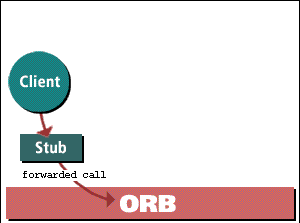
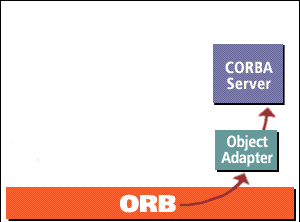
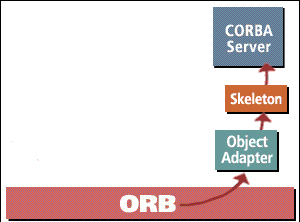
While the lifecycle from Stub to Skeleton is straightforward, the efficiency of your system depends on how well you implement the servant logic. In the next lesson, we will explore the specific duties performed by these components during a live method invocation.